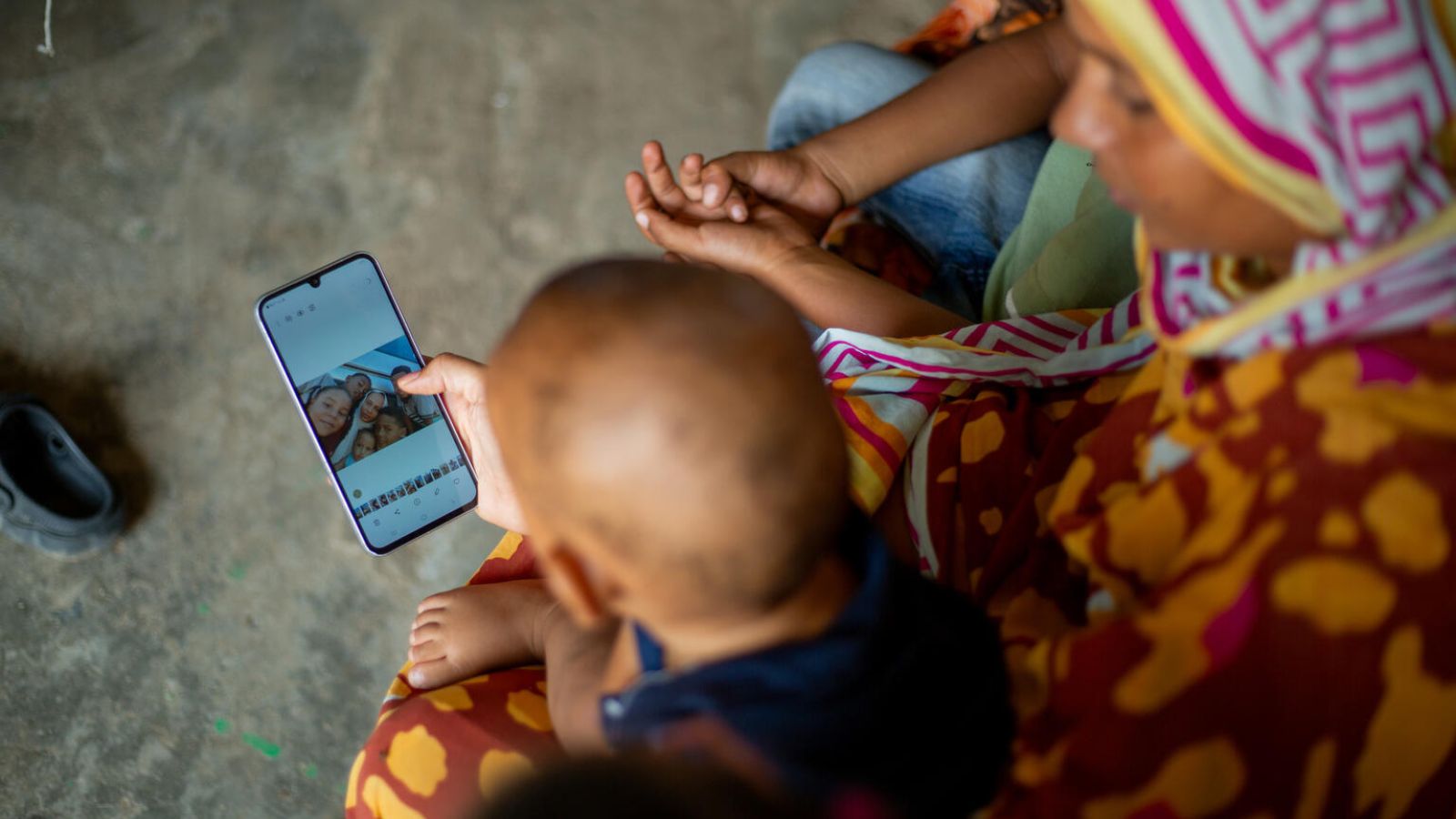
As your child grows, it is likely they are spending more and more time online. There are so many positive things about being online, like staying connected with friends and family, pursuing interests, and being part of communities. But it is not always a safe and positive experience for children.
Continue reading to see how you can help your child maximize all the good things the internet and digital technologies have to offer while protecting them against potential harm. And if you want to support our work, please click here - a donation can help millions of vulnerable children who need our help.

Have honest conversations with your children about who they communicate with and how, and who can see what they post online.
Explain that anything that goes online – pictures, videos, comments, things they share with others and what others post and share with them and about them – leaves behind a trail of information about them. To make sure they’re leaving a positive “digital footprint”, they should be mindful of what they do and say online.
Make sure they understand that discriminatory or inappropriate contact is never acceptable. No one should spread rumours or share hurtful or embarrassing stories or photos. What may seem like a harmless joke to one person can be deeply hurtful to others.
If your child experiences something online that makes them feel upset, uncomfortable or scared, encourage them to tell you or a trusted adult immediately.
Children often ‘know’ the perpetrators of online harassment or abuse, so it is important to help them to be alert and know how to respond to any problematic behaviors they encounter online.
Work with your child to establish rules on how, when and where to use devices.
It's important for children to understand the significance of being cautious before sharing anything online, particularly when emotions are running high. Once a message, photo, or video is posted, in some cases, it will become nearly impossible to delete or control who will see what you've posted or sent online.
Equally important is the right to privacy - everybody has the right to privacy. It is not okay to log into other people’s accounts, use their phones without permission, or share their information or photos.

Check that your child’s device is always updated and running the latest software and that privacy settings are on and configured to minimize data collection so that people don’t see any information that you don’t want them to see.
Help your child learn to keep personal information private. If your privacy settings are not secure, anyone can see your information.
Keep webcams covered when not in use. For younger children, tools such as parental controls like safe search can help keep online experiences positive.
Be cautious of free online resources, including educational ones. If your child is asked to provide a photo or their full name, be sure it is a trusted website.
You can change the privacy settings on your children's social media platforms to help control sensitive information – including locations. Sometimes it's best not to disclose too many details about your whereabouts and other sensitive personal information.
Children should know that what they share, and with whom, is very important. Sharing personal information like personal address, phone number, or bank details online should be done with much caution. Personal address, phone number, bank details, or other sensitive personal information, including social media passwords, should not be shared online with people you don't know very well (even with close friends, some things should be kept private — it's safer that way).
Being a parent is no easy task. You're reading this because you want to be able to give your children the best tools to be happy and to succeed in life. And this makes you a very special person. Millions of children deserve a safe and happy childhood. Your donation, no matter the size, can make a real difference in their lives. Please consider supporting our work by clicking here to donate.

Create opportunities for your child to have safe and positive online interactions with friends, family and you. Connecting with others can be an excellent opportunity for you to model kindness and empathy in virtual interactions.
Help your child recognize and avoid misinformation and disinformation, age-inappropriate content and content that can potentially cause anxiety or other harm. Introduce them to trustworthy sources of information.
Children can be exposed to advertising that may promote unhealthy foods, gender stereotypes, or age-inappropriate material.
Help them to recognize online ads and use the opportunity to explore together what is wrong with some of the negative messaging you see.
Spend time with your child to identify age-appropriate apps, games and other online entertainment. Be alert for apps that may have harmful content or pose privacy risks.

If your children have online classes, encourage them to be respectful of others and to be mindful of what can be seen on camera to maintain privacy.
Promote positive online behavior by practicing it yourself. Be mindful of the example you set and what you share online about your child, including their photos and videos.
Encourage your child to be kind online and to support friends and family by sending positive messages or emojis.
Be alert if your child appears to be upset or secretive with online activities. Reassure them that experiencing abuse or harassment is never their fault and they shouldn’t keep it a secret.
Children should know that before accepting a friend request, they should always have a look at the profile who sent the request. Is the person requesting to connect from the same town? What about common friends? Fake profiles where people try to take advantage, either financially or by other means, are very frequent. Sometimes people pretend to be someone they are not, and it’s hard to know if they are telling the truth. Not accepting random friend requests is perfectly acceptable.

Spending time online can be a great opportunity for your children to be creative, learn, use their voices to share their views and support causes that are important to them.
Encourage your child to use resources on the internet to help them get up and get moving, like online exercise videos for children and video games that require physical movement.
Remember to balance online activities with an active lifestyle and offline recreation for a healthy balance in all aspects of life.
As parents, it's our responsibility to create a safe space for children to grow, play, develop and enjoy life
If you learned something new today, share it with your friends, as maybe they will also find it useful. If you want to support our work, please send a gift below. Millions of vulnerable children will appreciate your help.
Your donation could:
- Give a child safe water. In emergencies, water supplies often become contaminated, heightening the risks of waterborne illnesses.
- Provide a severely malnourished child with lifesaving treatment. UNICEF is working with partners to reach children and treat them with Ready-to-Use Therapeutic Food.
- Support children's education.
With Africa home to the world’s fastest growing population of children and young people, the time to act is now.
Got questions? We've got answers:
We don’t currently have offline fundraisers collecting donations for UNICEF.
If you are approached by anyone claiming to be UNICEF, do not give any personal details or transfer funds.
You can support our efforts in helping vulnerable children by donating online on this secure official webpage. In case you have doubts about the authenticity of the page, please contact us at [email protected].
Please do not share any sensitive/banking card information with any individuals who may ask you for this type of information, either online or offline.
You can securely make a one-time and/or a monthly donation, on this page, by clicking on the donation buttons. Please select the donation amount that you want to give, then continue with the next steps to finish your donation.
No donation is too small, and any donation can help save children's lives.
You choose for how long you wish to donate: monthly or only once. In order to contribute to a fundamental change in the lives of vulnerable children, the longer you choose to get involved, the more powerful your donation will be. Vulnerable children’s lives can improve if you are a part of and contribute to the work that we are doing, and to the solutions that we are providing. By donating, you become an active part of the solution and change process.
A monthly donation is a recurring gift amount that you choose to send each month, and it is even more impactful, as this means that you'll be helping children every single day.
Your monthly gift will also enable us to plan effectively in our upcoming work, reduce costs and most importantly, reach even more children in need. The support and generosity of monthly donors contribute significantly to UNICEF's efforts to help vulnerable children.
Your donation is used to support UNICEF's programmes for children in need in Eastern and Southern Africa.
UNICEF encourages monthly donations to help us deliver sustainable, long-term solutions for children both in the region and globally.
Donating online through our UNICEF official websites is just as safe as any other online payment.
We use Secure Sockets Layer (SSL) encryption to protect your information and ensure that your donation is secure. Your card and personal data will be safe and secure.
UNICEF does not have access to your bank card details, we will only have access to the contact details you provide in the donation form: name, surname, e-mail and phone number.
Yes, you will receive an automatic "Thank You" email which can be used as a receipt for your donation.
UNICEF does not offer sponsorship of individual children. Instead, your donation goes to help many more of the most vulnerable children in Eastern and Southern Africa. This may include public health emergencies, quality education, ending child poverty, protection against violence and providing safe, clean water.
You can reach out to us by sending an email to [email protected]. We are here to answer any questions or address any concerns you may have.